







Introduction: The Hidden Reason Your Business Isn’t Profitable
Most service business owners don’t have a revenue problem.
They have a structure problem.
Revenue is coming in. Jobs are getting done. The team is busy.
But at the end of the month, there is little to no profit.
Sound familiar?
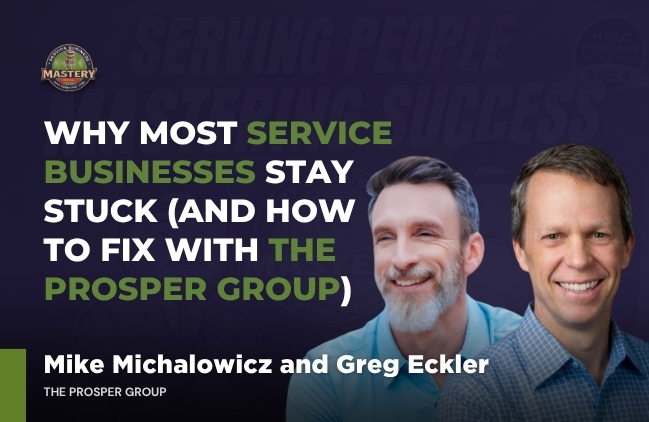
In this episode of Service Business Mastery, Tersh Blissett and Josh Crouch sat down with Mike Michalowicz and Greg Eckler to break down what’s really holding service businesses back and why most companies stay stuck longer than they should .
What they reveal is simple but uncomfortable:
Profitability is not about working harder.
It is about fixing what is fundamentally broken.
Background: Why “Busy” Doesn’t Mean Profitable
Many contractors operate in a constant state of motion:
- Jobs are booked
- Phones are ringing
- Technicians are working
- Payroll is covered
But despite all that activity, the business struggles.
Why?
Because activity is not the same as efficiency.
Mike explains that many businesses are filled with “busy work” that creates the illusion of productivity while delivering little real value .
This is where most service businesses get stuck.
Core Insight #1: The Real Profit Killer Is Hidden in Your Team
One of the most eye-opening insights from the episode is around staffing.
Most businesses are not understaffed.
They are overstaffed.
The “Return on Payroll” Problem
Mike introduces a concept called Return on Payroll (ROPE).
This measures whether your team is actually producing value.
What they often find:
- Businesses with 7 employees that should only have 4
- Teams filled with activity but lacking output
- Owners keeping employees out of loyalty instead of performance
And the harsh reality:
If your payroll is too high, your business cannot survive.
A Players vs B Players: The Math That Changes Everything
Mike shares a powerful example from The Container Store:
- 1 A player = output of 3 B players
- 1 B player = output of 3 C players
But here’s the real insight:
A players cost more individually
But cost less overall
Because:
- 3 B players cost significantly more than 1 A player
- 9 C players cost exponentially more
Meaning:
Hiring cheaper talent is often more expensive in the long run .
The Hard Truth About Employees
Not every employee is a bad hire.
Sometimes:
- They are in the wrong role
- They are misaligned with the business
- They are not set up to win
Mike puts it clearly:
Sometimes it’s the right person in the wrong seat .
And in other cases, letting someone go is actually the best thing for them.
Core Insight #2: Debt and Structure Are Silent Business Killers
If staffing is the visible problem, debt is the invisible one.
Greg explains that many businesses are technically profitable on paper but still struggle because of:
- High-interest debt
- Poor financial structure
- Cash flow pressure
In some cases, businesses are paying:
- 17%–25% interest rates
- Massive monthly obligations
- Unsustainable financial burdens
When Debt Becomes Unfixable
Not all businesses can be saved.
Greg shares that some companies are:
“Too far gone to fix”
But many are still recoverable with the right strategy:
- Refinancing
- Consolidation
- Restructuring debt
In one example, they helped a business:
- Reduce interest from 25% to 7%
- Save $20,000 per month
That kind of shift alone can completely change a business.
Profit on Paper vs Reality
One of the most important questions they ask business owners is:
“Where did your profit actually go?”
Because many owners report:
- $500,000 in profit on paper
- But nothing in their bank account
Which means:
They are not truly profitable.
Core Insight #3: Time, Focus, and Execution Are Everything
Another major takeaway is how businesses misuse time.
Parkinson’s Law in Action
Work expands to fill the time available.
Meaning:
- A 90-day project gets done on day 89
- A one-day deadline gets it done immediately
Mike explains that when time is compressed:
- Waste disappears
- Priorities become clear
- Execution improves dramatically
Why Most Work Is Unnecessary
According to Mike:
80% of what business owners do is unnecessary.
That includes:
- Low-value tasks
- Busy work
- Inefficient processes
Instead, businesses need to focus on:
Catalysts — the few actions that create the biggest results.
The Queen Bee Role: The One Thing That Drives Everything
One of the most important frameworks discussed is the Queen Bee Role (QBR).
This is:
The single most important activity that drives your business forward.
For example:
- In HVAC: Delivering exceptional service or installs
- In marketing: Generating qualified leads
- In operations: Ensuring execution consistency
Everything else should support that function.
The Prosper Group Approach: Why Partnership Beats Consulting
A major differentiator in this episode is the model Mike and Greg use.
Instead of:
- Charging hourly consulting fees
- Selling advice
They:
- Partner with businesses
- Execute alongside owners
- Get paid based on results
This creates alignment.
If the business wins, they win.
If the business struggles, they feel it too.
Action Steps: How to Improve Service Business Profitability
If you want to apply these lessons immediately, start here:
1. Audit Your Payroll
- Calculate revenue per employee
- Identify underperforming roles
- Reassign or remove inefficiencies
2. Evaluate Your Team Honestly
- Who are your A players?
- Who is in the wrong role?
- Who is holding the business back?
3. Analyze Your Debt
- List all interest rates
- Identify consolidation opportunities
- Reduce high-interest obligations
4. Find Your Queen Bee Role
- What drives customer value most?
- What activity creates the biggest impact?
- Focus your business around it
5. Eliminate Busy Work
- Remove unnecessary tasks
- Shorten timelines
- Focus only on high-impact actions
Podcast Insight
Clip — Why A Players Are Actually Cheaper
“1 A player delivers at the level of 3 B players… when you look at the real numbers, companies are paying more for lower performers.”
Conclusion: Fix the Right Problems First
Most service businesses don’t fail because of lack of effort.
They fail because they focus on the wrong things.
They:
- Hire based on cost instead of value
- Ignore financial structure
- Stay busy instead of being effective
The businesses that win do the opposite.
They simplify.
They focus.
They fix the fundamentals.
Because real growth is not about doing more.
It is about doing the right things better.
FAQs
What is service business profitability?
Service business profitability is the ability to consistently generate profit after covering payroll, expenses, and debt obligations.
Why do service businesses struggle with profit?
Common reasons include overstaffing, poor financial structure, high debt, and inefficient operations.
What is the Queen Bee Role in business?
It is the most critical function that drives value and success in a business. All other activities should support it.
How can I improve profitability quickly?
Start by reducing unnecessary expenses, optimizing payroll, and focusing only on high-impact activities.
Are A players worth the higher cost?
Yes. A players produce significantly more output, making them more cost-effective than multiple lower-performing employees.