







Introduction: Why Most Technology Projects Fail in Service Businesses
Most contractors are not struggling because they lack technology.
They are struggling because they are implementing the wrong technology in the wrong way.
A new software platform gets promoted at a conference. An AI tool promises to eliminate inefficiencies. A new automation system claims it will solve dispatching, communication, or customer service overnight.
So the company buys it.
Six months later, the team barely uses it.
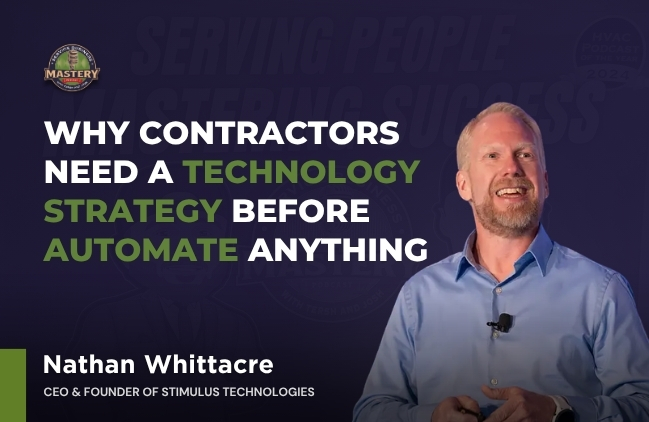
In this episode of the Service Business Mastery Podcast, Tersh Blissett sits down with Nathan Whittacre, founder of Stimulus Technologies, to break down why most technology initiatives fail and what service businesses need to do differently if they want automation and AI to actually improve operations.
The biggest takeaway is simple:
Technology is not the strategy.
It is only a tool.
The Biggest Technology Mistake Contractors Make
One of the strongest insights from the conversation is how business owners approach new technology backwards.
Nathan explains that many companies attend conferences, hear about a new platform, and immediately start searching for a problem the software can solve.
Tersh relates this directly to his own experience inside growing service businesses. Many owners return from conferences excited about a “game-changing” platform only to realize later that the software created more confusion than efficiency.
Instead of starting with the tool, contractors should start with the process.
The better question is:
What operational problem are we actually trying to solve?
That shift changes everything.
Because if a process is already inefficient, adding automation often magnifies the problem instead of fixing it.
Why Optimization Must Happen Before Automation
One of the most valuable moments in the episode happens when Tersh reinforces a principle many HVAC contractors learn the hard way:
You must optimize before you automate.
If your dispatching process is disorganized, automation will scale the confusion.
If your communication process is inconsistent, AI tools will simply make inconsistent communication happen faster.
Nathan explains that businesses should first map and analyze their processes manually before introducing technology into the workflow.
That allows companies to:
• Identify bottlenecks
• Remove unnecessary steps
• Clarify responsibilities
• Improve workflows before automation begins
Only then should technology enter the picture.
Why Technology Alone Never Solves the Problem
One of the most important themes throughout the episode is that technology does not fix culture.
People do.
Nathan repeatedly emphasizes that automation, AI, and software are only tools. Successful implementation depends on leadership, communication, and company-wide buy-in.
Tersh expands on this by pointing out that many teams become resistant to new systems because they have seen leadership repeatedly introduce software without fully implementing it.
That is why many expensive software projects fail.
Not because the software is bad.
But because:
• The team was never aligned
• The process was unclear
• Nobody championed the implementation
• Employees resisted the change
Without leadership, technology becomes another abandoned subscription on the company credit card.
Why Every Technology Rollout Needs a Champion
Nathan explains that every major implementation needs someone inside the company who fully owns the process.
Someone who believes in the change.
Someone who pushes the initiative forward even after the excitement wears off.
Depending on the size of the project, that champion could be:
• The owner
• A general manager
• A department leader
• A frontline employee
What matters is accountability.
Without ownership, most initiatives quietly disappear after a few weeks.
Tersh jokes during the episode that many employees already know the cycle:
The owner returns from a conference excited about a new tool, everyone tolerates it for two weeks, and eventually the company stops using it altogether.
That reality is more common than most contractors want to admit.
Why Leadership Matters More Than Software
This episode becomes just as much about leadership as technology.
Nathan explains that as businesses grow, owners must evolve beyond simply being good at the trade itself.
An HVAC owner may start the business because they are a great technician.
But growth introduces completely different responsibilities:
Finance, HR, operations, technology, cybersecurity, and compliance all become leadership responsibilities as the company scales.
Tersh highlights how overwhelming that shift can feel for contractors who originally entered the trades because they enjoyed technical work, not because they wanted to become technology strategists or cybersecurity experts.
That complexity requires leaders to think strategically instead of reactively.
The Cybersecurity Risk Most Small Businesses Ignore
One of the most practical sections of the episode focuses on cybersecurity.
Nathan explains that most cyber attacks against small businesses still begin through email.
The biggest risks include phishing emails, fake invoices, social engineering attacks, password theft, and fraudulent payment requests.
And AI is making these attacks significantly more convincing.
Hackers can now use AI to:
• Mimic writing styles
• Personalize messages
• Gather social media information
• Create realistic communication
That makes employee training more important than ever.
How AI Is Changing Cybersecurity
Tersh shares a real example from the episode involving a phishing attempt that impersonated his business partner Josh Crouch using highly personalized messaging and realistic formatting.
Nathan explains that AI now allows attackers to generate personalized phishing campaigns in seconds by scanning public information from:
• LinkedIn
• Facebook
• Websites
• Social media profiles
That means many attacks no longer look obviously fake.
They look real because they are built using real information.
The Most Important Cybersecurity Tools for Contractors
According to Nathan, there are several foundational tools every contractor should implement immediately.
Use Two-Factor Authentication
Two-factor authentication remains one of the simplest and most effective cybersecurity protections available.
Even though employees often find it inconvenient, it dramatically reduces account compromise risks.
Stop Saving Passwords in Web Browsers
Nathan strongly warns against allowing Google Chrome or other browsers to store passwords.
Instead, businesses should use dedicated password managers like:
• LastPass
• 1Password
• Bitwarden
Add Advanced Email Protection
Out-of-the-box Gmail or Microsoft 365 security is often not enough for growing businesses.
Nathan recommends implementing advanced email filtering and AI-driven spam protection tools to reduce phishing exposure.
Why Small Businesses Still Need IT Strategy
A common misconception is that smaller HVAC companies do not need structured IT planning.
Nathan disagrees.
While companies under five employees can often manage basic systems independently, complexity increases rapidly as businesses grow.
Once companies reach around 10 employees, technology management usually becomes too large for the owner to handle alone.
At that point, contractors often need support with:
• Cybersecurity
• Workflow automation
• Software integration
• Data management
• Team communication systems
Without a clear strategy, technology quickly becomes fragmented and inefficient.
Why Employee Training Matters More Than Software
One of the most important reminders in the episode is that employees are often the weakest security link.
Not because they are careless.
Because they are busy.
Hackers intentionally create urgency to force quick decisions before someone has time to slow down and verify the request.
Nathan recommends training teams to pause before making financial changes or responding to urgent account requests.
Tersh reinforces this point by sharing examples of payroll and direct deposit scams that can easily happen when teams move too quickly without verification.
Sometimes, a simple phone call can prevent a major financial loss.
The Bigger Lesson About Technology in Service Businesses
The core message of this episode is not anti-technology.
It is anti-chaos.
Technology absolutely can improve service businesses.
AI can improve workflows.
Automation can save time.
Software can create operational efficiency.
But only when the business itself is prepared for it.
Without process clarity, leadership alignment, and team buy-in, even the best technology becomes another unused expense.
Conclusion: Technology Should Support Your Business, Not Complicate It
The HVAC industry is entering a period where AI, automation, and digital tools will become impossible to ignore.
But contractors who succeed will not be the ones chasing every new platform.
They will be the ones who:
• Understand their processes
• Optimize operations first
• Train their teams properly
• Implement technology strategically
As both Nathan Whittacre and Tersh Blissett emphasize throughout the episode, technology works best when it supports strong leadership, not when it attempts to replace it.
Because technology alone does not create great businesses.
Strong leadership does.
FAQs
What is a technology strategy for contractors?
A technology strategy helps contractors align software, automation, and digital tools with actual business goals and operational processes.
Why do technology implementations fail in HVAC companies?
Most fail because businesses automate inefficient processes without first optimizing workflows or gaining team buy-in.
How can contractors improve cybersecurity?
Contractors should use two-factor authentication, password managers, advanced email protection, and employee cybersecurity training.
What is the biggest cybersecurity threat to small businesses?
Phishing emails and social engineering attacks remain the most common threats.
When should a contractor hire outside IT support?
Most businesses benefit from professional IT support once they reach around 10 employees or begin managing more complex systems.