







Introduction: The Menu Is Too Big
Josh Zolin has a specific way of explaining why most home service businesses struggle to grow: it’s the Cheesecake Factory problem. Hand someone a seven-page menu and they’ll spend ten minutes paralyzed by indecision. Hand them In-N-Out’s four items and they order in seconds.
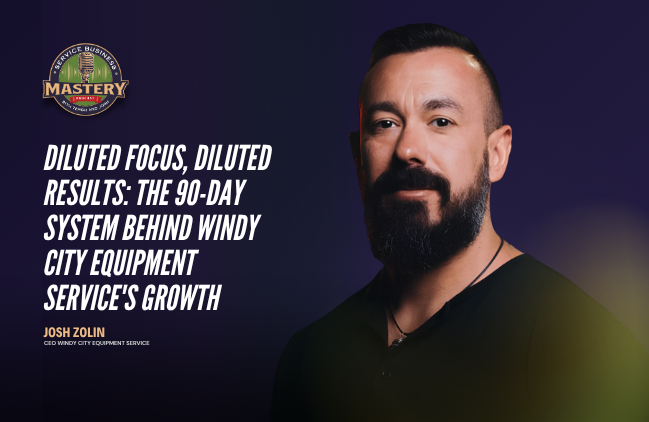
Zolin is CEO of Windy City Equipment, an HVAC, refrigeration, and kitchen equipment company based in Phoenix, Arizona, with branches across the Southwest. He’s also the author of “Blue Is the New White” and host of the podcast “Everything They Don’t Tell You.” He joined Tersh Blissett and Josh Crouch on the Service Business Mastery podcast to talk through a single focus business scaling strategy that changed how his entire company operates, along with a broader conversation about identity, leadership, and what happens once a founder’s business no longer needs them doing the work they started out doing.
This article breaks down the 90-day single-focus system Zolin uses to hit his goals consistently, along with his perspective on staying relevant as AI reshapes how people perceive the trades.
Why This Matters Right Now
Most business owners run into the same trap Zolin described from his own earlier years: identifying four or five real problems in the business, like hiring, team development, sales process, and KPI tracking, and trying to fix all of them simultaneously. The result, in his experience, was constant effort with very little to show for it, the business equivalent of pulling teeth.
The fix he adopted came from a book called “The Science of Scaling,” featuring a line that reframed how he runs the company: diluted focus will always get you diluted results. Spread a team’s attention across too many priorities, and the business ends up making meaningful progress on none of them.
Core Insight #1: One Company-Wide Focus Every 90 Days
How the system works:
- Every 90 days, Windy City Equipment Service picks exactly one focus for the entire company, not just leadership, not just management, every single employee down to the parts runner.
- If the quarter’s focus is recruiting, every department, every conversation, and every resource allocation decision gets filtered through that lens, until the 90 days are up.
- The system doesn’t ignore everything else. An ongoing “issue list” still tracks other known problems in the business, they simply wait their turn rather than competing for attention against the current priority.
- Zolin compared the effect to a magnifying glass concentrating sunlight into a single point: the same total amount of effort, focused narrowly enough, produces dramatically more result than that same effort spread across several priorities at once.
Why this feels harder than it should, according to Zolin: the instinct in business is that doing more produces more. Committing to a single focus can feel like leaving value on the table, even when it isn’t. Zolin’s honest admission: it isn’t actually harder to run a business this way, it’s scarier, because it requires trusting that narrowing the lens will outperform spreading resources thin.
Core Insight #2: Choosing the Right Focus Isn’t as Complicated as It Sounds
Real example from the episode: Zolin described losing three technicians in two months to a fast food chain that had started actively recruiting his own employees straight out of his customer base. That kind of clear, urgent signal makes choosing the next 90-day focus, in his case, recruiting, fairly obvious rather than a difficult strategic debate.
Practical guidance for applying this system:
- Zolin generally doesn’t agonize over whether he’s picked the “right” priority, largely because his ongoing issue list already tells him which problems are real. The question is less about identifying problems and more about sequencing them.
- Crouch drew a parallel to In-N-Out’s famously narrow menu, the most profitable major fast food chain despite offering a fraction of the options competitors do, and applied the same logic to a plumbing business narrowing its service offerings to a handful of specialties (like drain cleaning, jetting, and trenchless work) rather than trying to be the go-to option for all twenty-plus services a typical plumber could technically offer.
- Zolin acknowledged the tradeoff directly: a business can absolutely grow by expanding into more service categories, selling more to the same customer base, but it will likely grow slower and with more operational complexity than a business willing to say no to some of those opportunities.
- One workaround for larger, multi-trade businesses: focus can be segmented by department once each division reaches sufficient size. Windy City runs HVAC, refrigeration, and kitchen equipment as effectively five separate profit centers (including maintenance and install departments), and each can carry its own singular focus rather than forcing one company-wide priority across fundamentally different business lines.
Core Insight #3: Redefining Your Role as the Business Outgrows You
The conversation’s most personal thread covered a challenge that hits almost every founder eventually: what to actually do once the business no longer needs you doing the work you built it on.
Zolin’s framing: this is fundamentally a question of identity, not productivity. He described going through this transition repeatedly throughout his career, first as the technician turning the wrench, then as the dispatcher directing technicians, then stepping back further as he hired a dedicated dispatcher. Each time, the same question resurfaced: what do I do now?
His current approach: rather than trying to stay busy for its own sake, Zolin now asks a simple, recurring question, “where can I be most valuable today?” Often, the honest answer points toward coaching: sitting down with a leader who mishandled a conversation the week before and helping them work through it, not by fixing it for them, but by helping them build the capability to handle it better next time. He specifically hires people who want to improve, which makes this kind of internal coaching one of the highest-leverage things he can personally contribute once the day-to-day logistics are handled by his team.
An Additional Insight: AI Is Changing the Trades’ Reputation in Two Directions at Once
Zolin and the hosts spent time on a tension he’s noticed firsthand: AI is simultaneously making the trades more appealing and distorting public perception of what success in the trades actually requires.
- On one hand, growing anxiety about AI displacing white-collar jobs is pushing more people to consider hands-on, skilled trade work as a more AI-resistant career path.
- On the other hand, social media tends to showcase only the highlight reel, six-figure earners, rapid business growth, without the years of difficult, unglamorous work underneath those results. Zolin was direct that this creates a distorted expectation, especially for career-changers with no direct trades experience who assume the business side will be simple.
- He pointed to a broader information overload problem tied to AI directly: because tools like Claude and ChatGPT can be prompted toward whatever answer a person wants to hear, some business owners are unintentionally reinforcing bad ideas by asking biased questions and receiving confirming answers, rather than getting genuinely objective feedback.
Conclusion
Zolin’s core message applies well beyond a single 90-day cycle: growth rarely comes from doing more things simultaneously. It comes from having the discipline to choose one priority, commit real company-wide attention to it, and resist the instinct to spread resources thin just because more opportunities exist.
The same discipline applies to leadership itself. As a business matures and a founder’s original role disappears, the goal isn’t to manufacture busywork, it’s to honestly assess where genuine value can still be added, even when that means stepping back from the tasks that once defined the job entirely.
FAQs
What is a single focus business scaling strategy? It’s an approach where a company commits every resource and every team member’s attention to one specific priority over a defined period, typically 90 days, rather than pursuing multiple goals simultaneously, based on the idea that concentrated effort produces faster, more measurable results.
Why does narrowing service offerings sometimes help a business grow faster? Offering fewer, more specialized services allows a business to build deeper expertise and operational efficiency in those areas, while potentially building referral relationships with other businesses that handle the services outside that narrower focus.
How do you decide what a company’s 90-day focus should be? Most businesses already have a running list of known operational issues. The clearest priority is often the one causing the most urgent or visible damage, such as a sudden wave of employee turnover, rather than requiring an extensive strategic debate to identify.
What should a business owner do once their original role in the company becomes unnecessary? Rather than manufacturing busywork, it can help to regularly ask where you can add the most genuine value in the business today, which for many owners eventually shifts toward coaching and developing leadership within their team.
Does AI make the skilled trades a safer career choice than white-collar work? Some evidence suggests more people are considering trade careers due to concerns about AI displacing office jobs, though experienced professionals caution that success in the trades still requires significant skill development and isn’t guaranteed simply because a job is less exposed to AI automation.
What is “The Science of Scaling” and how does it relate to business focus? It’s a book referenced in the episode that introduced the concept “diluted focus will always get you diluted results,” used as the foundation for the single-focus, 90-day operating system described throughout this article.