Our Sponsors:





Our Affiliates:




Introduction: You’re Losing Money Fastest When Business Feels Best
Here’s an uncomfortable pattern Shaun Ritchey has seen across hundreds of home service businesses: the busier a company gets, the more money it quietly leaves on the table. Revenue is up, the phones won’t stop ringing, and it feels like everything is working. Meanwhile, roughly a third of those calls never get answered at all.
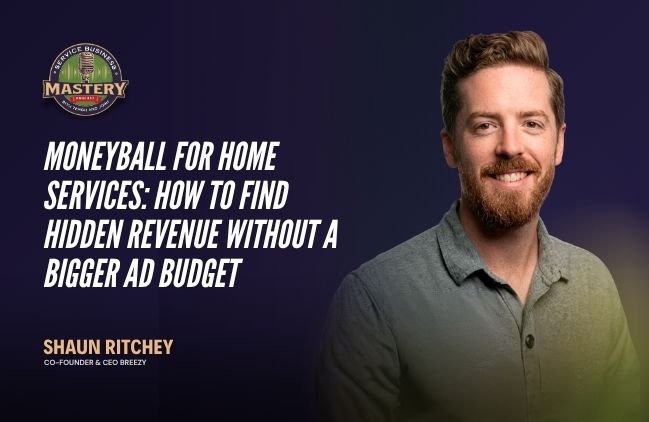
Shaun Ritchey, co-founder of Breezy, joined Tersh Blissett and Josh Crouch on the Service Business Mastery podcast to apply the Moneyball philosophy, made famous by the Oakland A’s, to home service businesses competing against private-equity-backed rivals with far bigger marketing budgets. The premise: you don’t need to outspend the competition if you can find the hidden, overlooked inefficiencies already sitting inside your own business.
This article breaks down the specific missed call revenue problem Ritchey described, the data behind it, and the practical framework for fixing it before spending another dollar on lead generation.
Why This Matters Right Now
Private equity has been aggressively rolling up home service businesses, giving well-funded competitors access to marketing budgets independent contractors simply can’t match. Crouch compared it directly to Major League Baseball’s payroll gap: trying to out-spend a private-equity-backed competitor on Google Ads is the equivalent of a small-market team trying to outbid the Yankees or Dodgers for star players. It’s not a winnable fight on pure budget alone.
The Moneyball answer isn’t to spend more. It’s to find the specific, quantifiable inefficiencies most businesses aren’t even tracking, the same way the Oakland A’s found undervalued players other teams overlooked. For home service businesses, Ritchey’s data points to the same conclusion: fix the leaks before adding more water to the bucket.
Core Insight #1: The Missed Call Problem Is Bigger Than Most Owners Realize
Bite-size takeaways:
- On average, roughly 27 to 30% of inbound calls to home service businesses go unanswered, according to data Ritchey’s team has studied. That’s close to one in every three calls.
- Around half of those missed calls happen after hours or on weekends. The rest happen during business hours, when staff are already on another call, in a meeting, or otherwise tied up.
- Speed to lead compounds the problem. A customer is roughly three to four times more likely to book with the business that responds within the first 60 seconds of outreach, compared to a callback even 30 minutes later.
- Younger, web-first homeowners are even less forgiving. Ritchey pointed out that a growing share of the customer base, particularly millennials and younger, will simply move to the next business rather than wait for a callback, the same way a consumer today expects to book a restaurant reservation online rather than call and wait on hold.
- Missed calls aren’t the only leak. Crouch shared a real example of a CSR who filled the entire schedule with low-margin, discounted tune-up calls, then turned away a homeowner reporting a tripped breaker on an aging outdoor unit, a call that could easily have turned into a $15,000-$20,000 system replacement. That’s a answered call that still got thrown away because it wasn’t classified as bookable.
Core Insight #2: Where AI Actually Helps (and Where It Doesn’t)
Ritchey was direct about the limits of AI in customer-facing roles, pushing back on the idea that AI can or should replace a business’s human team.
What AI is genuinely good at, according to Ritchey:
- Round-the-clock availability for answering questions
- Talking to multiple customers simultaneously, something no single human CSR can do
- Generating written responses and content quickly
- Executing exactly what it’s trained to do, for better or worse
What AI still struggles with: empathy, tone-matching, humor, and the kind of nuanced objection handling a well-trained human excels at. Crouch reinforced this with a personal anecdote about a frustrating AI drive-thru experience, noting that today’s AI voice tools are still fundamentally following a structured workflow rather than genuinely improvising a conversation.
The real opportunity, per Ritchey: use AI agents specifically to absorb the low-leverage call volume that currently ties up human CSRs, spam calls, vendor calls, high-maintenance repeat callers, so the human team has more bandwidth for the calls that actually require empathy, like a customer with a broken system during a heat wave. The goal isn’t replacement. It’s freeing up the team’s time for the interactions that matter most.
Ritchey also emphasized that AI agent performance is entirely a function of training quality, not the underlying technology itself. Breezy’s best-performing clients see roughly 90%+ booking rates on qualified calls, while their lowest-performing clients sit in the 50s, a gap almost entirely explained by how well the agent’s opening greeting, objection handling, and script were built and refined.
Core Insight #3: The Three Moneyball Levers Ritchey Recommends Checking First
Rather than jumping straight to more advertising spend, Ritchey outlined three specific areas he advises contractors to examine first.
- Your existing customer base. Most companies are sitting on a large, underutilized asset in their past customer list, an audience that already trusts the business and doesn’t require new acquisition spend to reach again.
- Leaks in the sales funnel. Before spending more on lead generation, identify exactly where calls, web leads, and bookable opportunities are falling through, whether that’s missed calls, mis-classified leads, or slow response times.
- Pricing. With modern CRM data, businesses can now analyze gross margin by repair type in ways that used to be tedious or impossible, surfacing services that are underpriced relative to their actual margin.
Real example from the episode: Ritchey described launching Breezy’s AI agent for a three-truck HVAC shop in Arizona. The client booked three extra jobs within the first day, and 55 additional jobs within about five weeks. The owner estimated a 25 to 30% increase in overall client volume as a direct result of capturing calls that would have otherwise gone unanswered.
Ritchey noted the break-even point on the service is typically just one or two additional booked jobs per month, meaning the cost of fixing the missed call problem is often trivial compared to the revenue it recovers.
A Word From Our Partner
This episode is brought to you by Breezy. If missed calls and slow response times are costing your business real revenue, Breezy’s AI agents are built specifically to close that gap, answering calls around the clock and helping you convert more of the leads you’re already paying for.
Capture 25-30% more clients with Breezy AI Agents. Use code “SBM” to book a demo and get $500 on us: https://getbreezyapp.com/schedule-demo
Conclusion
The Moneyball lesson for home services isn’t about finding a silver bullet. It’s about recognizing that most businesses already have significant, recoverable revenue hiding in plain sight, missed calls, mis-qualified leads, and underpriced services, well before a bigger marketing budget would even matter. Fixing those leaks first means every future marketing dollar works harder, rather than pouring more water into a bucket that’s still leaking.
For any home service business feeling outgunned by private-equity-backed competitors with bigger ad budgets, the practical starting point isn’t to spend more. It’s to measure exactly how many calls, leads, and bookable opportunities are currently slipping away, and fix that before anything else.
FAQs
How many calls do home service businesses typically miss? Industry data suggests roughly 27 to 30% of inbound calls to home service businesses go unanswered, split roughly evenly between after-hours and weekend calls and calls missed during business hours due to staff availability.
Why does speed to lead matter so much? Customers are roughly three to four times more likely to book with a business that responds within the first 60 seconds of contact, compared to a callback even 30 minutes later. Slower response times often mean the customer has already contacted a competitor.
Can AI voice agents replace human customer service reps in home services? Not entirely. AI performs well on repetitive, structured tasks like answering after-hours calls and handling routine questions, but still lacks the empathy and nuanced tone-matching required for emotionally charged or complex customer interactions, which are best handled by trained staff.
What is the “Moneyball” approach to growing a home service business? It’s a strategy focused on identifying and fixing overlooked inefficiencies, such as missed calls, sales funnel leaks, and mispriced services, rather than competing purely on advertising spend against larger, better-funded competitors.
How much revenue can fixing missed calls actually recover? Case studies referenced in the episode showed a three-truck HVAC company gaining 55 additional booked jobs in about five weeks after addressing missed calls, with the business owner estimating a 25 to 30% increase in overall client volume.
What determines whether an AI voice agent performs well? Training quality is the primary factor. Well-trained agents with strong greetings, clear objection handling, and refined scripts can achieve booking rates above 90%, while poorly trained agents may convert as low as 50% of qualified calls.