Our Sponsors:




Our Affiliates:




Introduction: The Accidental Brand That Changed Everything
Some of the best branding ideas aren’t planned. They’re discovered.
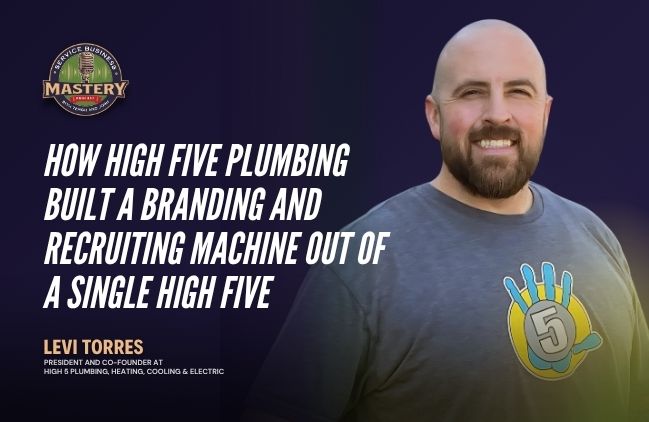
Levi Torres, founder of High Five Plumbing, Heating, Cooling & Electric in Denver, joined the Service Business Mastery podcast to share how a spontaneous high five between him and his wife, while brainstorming a company name at their kitchen table, turned into a full branding and recruiting engine responsible for helping the company grow 67% in a single year.
This article breaks down the home service business branding strategy Torres shared with hosts Tersh Blissett and Josh Crouch: how a simple gesture became a documented KPI, how consistent social content solved recruiting for good, and how tightly built internal systems let High Five add two new trades in a single year without missing a beat.
Why This Matters Right Now
Most home service businesses treat branding and recruiting as separate problems. Torres built High Five around the idea that they’re the same problem. Instead of running job ads that promise a paycheck, High Five uses daily social content to show, in real time, exactly what it’s like to work there. By the time a candidate walks in for an interview, they’ve usually already decided whether they want the job.
That approach has made hiring a non-issue for the company. As Torres put it, High Five has never failed to fill an open technician or dispatcher role when they needed one. In an industry where finding good people is consistently cited as the top business challenge, that alone makes this a strategy worth studying.
Core Insight #1: Turn One Authentic Idea Into a Trackable Culture Metric
The “high five” concept started as an accident. Torres high-fived a frustrated customer at a supply house one day, just to lighten the mood, and watched it completely shift the person’s body language. He started testing it everywhere: cash registers, gas stations, anywhere he could. The reaction was consistent enough that he built it directly into the company’s operations.
Bite-size takeaways:
- Every service call at High Five ends with a selfie of the technician high-fiving the customer. During periods when physical contact wasn’t advisable, the team adapted to a “virtual high five” rather than dropping the concept entirely.
- The number of high five photos a technician captures per day is an actual tracked KPI, not just a marketing gimmick. It reflects genuine customer rapport, not just job completion.
- New hires get a tour of the facility, including the “high five wall” employees touch when they join the team, before they even sit down for a formal interview. Candidates who aren’t a cultural fit often self-select out at that stage, which Torres treats as a feature, not a loss.
- It typically takes about 30 days for a new technician to fully buy into the culture and start hitting high five and KPI targets consistently. Torres describes this as a natural adjustment period, not a red flag.
Core Insight #2: Consistent Social Content Solves Recruiting Before the Interview Ever Happens
High Five’s real branding breakthrough came in late 2018, when the team stopped posting occasional promotional discounts and started posting daily content across every platform, treating their social presence like reality TV.
Real example from the episode: Torres described the shift explicitly: rather than posting “$25 off a water heater,” the team began sharing high five photos, training videos, and moments of new hires touching the high five wall on their first day. Engagement transformed almost immediately, and so did recruiting outcomes.
Industry implications for hiring and marketing:
- Prospective employees now research a company on social media before ever applying, the same way customers research a business before booking. If the content is authentic and consistent, that pre-interview research does a large part of the recruiting work.
- Crouch shared a parallel example from his own company: a candidate for a director-level position said he had been looking forward to the interview for two weeks purely because of the brand’s content and online presence.
- The strategy works both ways. Because High Five’s daily reality matches what’s shown online, when candidates arrive for an in-person tour, they’re seeing confirmation of what they already researched rather than a surprise. That consistency builds trust before a single interview question is asked.
- Torres also ties this directly to sales performance: technicians who are proud of their company and can genuinely explain why they work there (“a why-me statement”) come across as more credible to homeowners, which Torres estimates has a meaningful effect on closing rates.
Core Insight #3: Systems Are What Let You Scale Into New Trades Without Starting Over
Beyond branding, the most tactical part of the conversation covered how High Five expanded from a single-trade plumbing business into a three-trade company (plumbing, HVAC, and electrical) in the span of about a year, without building new operational systems from scratch.
- Document every position as a complete operating system. High Five maintains a documented playbook for every role in the company, hosted in Trainual, complete with handbooks, quizzes, and videos.
- Let employees maintain their own systems. Every two weeks, managers assign team members specific documented systems to review and suggest edits to. This keeps the content accurate without requiring ownership from a single person, and it builds employee buy-in because they had a direct hand in shaping the process.
- Remove the emotional layer from accountability. Torres was direct about this: when a documented system exists and an employee helped refine it, holding them accountable to it becomes a matter of following an agreed-upon standard, not a manager’s personal opinion.
- Build in flexibility, not rigidity. High Five gives technicians options within the system rather than one-size-fits-all rules: three uniform color choices, 23 hat styles, and five different shift schedules. Torres’s reasoning: a system with built-in choice removes the common objection that structure makes people feel like robots.
- Expand trades by editing, not rebuilding. When High Five launched its HVAC division, Torres said the existing systems required almost no structural changes, just swapping the word “plumbing” for “HVAC” throughout existing training and onboarding material. The same approach applied when electrical launched shortly afterward.
- Wait for the right person, not just the right timing. Torres had originally planned to launch HVAC in 2025 but moved the timeline up to 2024 specifically because the right technical hire became available. He deliberately avoided expanding into a new trade without someone who already understood and believed in the company’s brand and systems.
Conclusion
High Five’s growth wasn’t built on a bigger ad budget or aggressive discounting. It was built on treating culture and branding as measurable, trainable, and consistent enough to show up the same way on social media as it does inside a customer’s home. That consistency did double duty: it built trust with homeowners and functionally solved recruiting, all without a dedicated HR department chasing candidates.
For any home service business struggling to hire or struggling to differentiate on price alone, Torres’s approach offers a clear alternative: build something specific enough to be memorable, document it thoroughly enough to scale, and be consistent enough on social media that by the time someone walks through the door, they already know whether they belong there.
FAQs
How does social media help with recruiting in home service businesses? Consistent, authentic social content lets prospective employees research what it’s actually like to work at a company before ever applying. When the content matches reality, candidates arrive at interviews already convinced, which speeds up hiring and improves retention.
What is a “why-me statement” in a home service business? It’s a personal explanation a technician can give a homeowner for why they specifically, and their company, are the right choice for the job. Genuine pride in the company tends to translate directly into stronger customer trust and higher close rates.
How can a home service business add a new trade without starting from scratch? Building thorough, documented operating systems for every role in advance makes it possible to expand into a new trade by adapting existing training and processes rather than creating entirely new ones from the ground up.
Why give employees choices within company systems instead of strict rules? Providing reasonable options, such as multiple uniform styles or flexible shift times, reduces the common complaint that structured systems feel impersonal or robotic, while still maintaining consistency and accountability.
How long does it typically take for a new hire to fully adopt a strong company culture? In High Five’s experience, it takes roughly 30 days for a new employee to move past initial hesitation and start consistently following culture-driven habits and KPIs.
Does expanding into multiple trades hurt brand consistency? Not if the branding and internal systems are built to be trade-agnostic from the start. High Five’s core brand identity and operational systems transferred to HVAC and electrical divisions with minimal changes.