
Our Sponsors:




Our Affiliates:




Introduction: It’s Not the Market. It’s You.
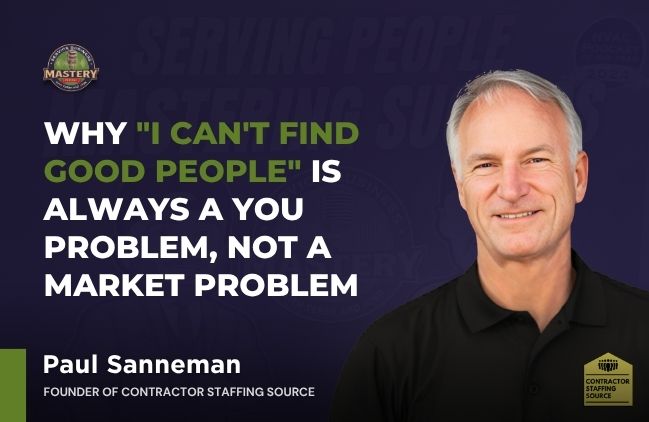
If you’ve ever said “there just aren’t any good people out there,” Paul Sanneman has a blunt response: yes, there are, and the problem is almost never the market.
Sanneman is the founder of Contractor Staffing Source, a recruiting and applicant tracking company built specifically for residential contractors. He’s coached over 2,000 contracting businesses and personally overseen the hiring of more than 2,500 employees, screening roughly 500,000 resumes to get there. On a recent episode of the Service Business Mastery podcast, Sanneman sat down with hosts Tersh Blissett and Josh Crouch to lay out exactly why most contractors struggle to hire, and the specific, repeatable process that fixes it.
This article breaks down Sanneman’s contractor recruiting strategies: the limiting beliefs holding business owners back, the step-by-step hiring system that gets a 95% success rate, and what it actually costs to get this wrong.
Why This Matters Right Now
Recruiting has never been more competitive for skilled trades and construction businesses, and Sanneman warns that private equity is starting to change the game. He describes it as the “Walmartization of construction”: well-capitalized outside investors are entering local markets, applying professional marketing and recruiting practices, and out-competing contractors who still rely purely on reputation, friends, and family to build their teams.
At the same time, AI is unlikely to replace hands-on trade labor anytime soon, which means the businesses that master hiring now are positioned to scale while competitors who “wait for someone to walk in the door” get left behind.
Core Insight #1: Five Limiting Beliefs Killing Your Hiring Pipeline
Sanneman identified five specific mindsets that quietly sabotage recruiting at most contracting businesses.
Bite-size takeaways:
- “I only recruit when I need somebody.” Sanneman compares this to a sports team that only looks for players once someone gets injured. Recruiting should run continuously, not as a one-off project triggered by a vacancy.
- “Employees are expensive.” More employees, when they’re the right employees, generally means more revenue and more capacity. The cost isn’t the headcount, it’s the wrong hire.
- “We can do this ourselves.” Most owners wouldn’t attempt their own accounting or fix a modern car engine without training. Recruiting is a specialized skill with the same logic: an amateur approach produces amateur results.
- “We should only recruit within construction.” Some of Sanneman’s best placements came from completely unrelated industries, including wedding planners who transitioned into selections coordinators. His reasoning: personality and work ethic transfer between industries, but industry knowledge is teachable. You can train someone on the trade. You can’t train who they are as a person.
- “Hire fast and fire slow.” Sanneman flips this completely: hire slow, fire fast. Rushing a hire increases the odds of a bad fit, while keeping a toxic or dishonest employee too long, out of guilt or hope, can undo years of culture-building in a matter of months.
Core Insight #2: The Seven-Step Hiring System With a 95% Success Rate
The core of the conversation was a detailed walkthrough of the exact process Contractor Staffing Source uses to vet candidates before a job offer ever goes out.
- Write a job ad that makes someone want to quit their current job. Sanneman is direct about this: a bare-bones job description won’t move a gainfully employed, high-performing candidate. The ad needs to sell the opportunity, not just list requirements.
- Post everywhere, not just one job board. Sanneman’s team distributes openings across roughly 100 job boards and platforms simultaneously, including LinkedIn and Facebook, plus a proprietary internal database of past applicants.
- Respond to every applicant in real time. This is the step most contractors fail at. Sanneman notes that filling one role typically requires screening around 300 applicants, and the businesses that respond within minutes capture candidates before competitors do. A slow response is often the single biggest reason quality candidates disappear.
- Run a full assessment, not just a resume review. This includes a personality profile benchmarked against people who’ve already succeeded in that specific role, a separate integrity and honesty assessment, and a cognitive or IQ assessment. Sanneman’s team has profiled roles against outcomes from roughly 300,000 completed assessments, so they know what a high-performing project manager, salesperson, or technician tends to look like on paper before an interview ever happens.
- Conduct a structured video interview. This step fills in what an assessment can’t capture, using role-specific questions designed to surface honesty, communication style, and real experience versus resume padding.
- Complete background and reference checks. Sanneman calls this non-negotiable. Skipping it is how contractors end up hiring someone whose resume doesn’t match their actual capabilities.
- Build a real onboarding process. A strong hire can still fail without proper onboarding, so the process doesn’t end at the offer letter.
Sanneman was candid that this entire process can be run in-house, but warned that most contractors underestimate the time cost. Contractor Staffing Source offers it as a flat monthly service starting around $1,500 a month, covering up to five open positions simultaneously, rather than charging a percentage of first-year salary the way many traditional recruiting firms do.
Core Insight #3: What a Bad Hire Actually Costs Your Business
Beyond the recruiting process itself, Sanneman and the hosts dug into the real cost of hiring poorly, and of waiting too long to let a bad fit go.
Real example from the episode: Crouch shared a story about an employee who was well-liked, fun to work with, and clearly not the right long-term fit. The team kept him roughly six months past when they should have made a change, largely because of the emotional discomfort of letting someone go who felt like part of the team.
Industry implications:
- Sanneman estimates the average cost of a bad hire at around $50,000, a figure that includes lost productivity, retraining, turnover, and the ripple effect on team morale.
- “B players” are often more damaging long-term than obviously bad hires, because they’re never quite bad enough to justify firing, yet they never elevate the team’s performance either. Blissett noted that C and D players tend to get removed quickly, but B players “just hover,” collecting a paycheck without growing the business.
- Sanneman’s litmus test for any current employee: if you were starting your business over tomorrow, would you rehire this person? If the honest answer is no, that’s the signal to make a change, not a reason to wait.
- Keeping an underperforming employee sends a message to the rest of the team about what standard of performance and honesty is actually tolerated, whether that’s the intent or not.
Conclusion
The businesses winning the talent war in construction and home services aren’t necessarily paying more. They’re running recruiting like an ongoing marketing function rather than a reactive scramble, and they’re using a structured, repeatable vetting process instead of a resume and a gut feeling.
Sanneman’s core message is uncomfortable but useful: if hiring feels broken in your business, it’s rarely the market, the economy, or a lack of available talent. It’s the process, or the lack of one. Fixing that starts with recruiting continuously, screening thoroughly, and having the discipline to fire fast when someone clearly isn’t the right long-term fit.
FAQs
What is an applicant tracking system (ATS) for contractors? An applicant tracking system is software that manages the entire hiring pipeline, similar to a CRM but built for recruiting. It distributes job postings to multiple job boards, tracks applicants in one place, and helps standardize the screening and interview process.
Why is responding to job applicants quickly so important? Top candidates, especially those who are currently employed, typically have multiple opportunities available. Responding within minutes rather than days significantly increases the odds of engaging a strong applicant before a competitor does.
Should contractors only hire people with construction experience? Not necessarily. Personality traits, integrity, and work ethic are harder to teach than industry-specific knowledge. Candidates from unrelated fields, such as event planning or coordination roles, can succeed in construction positions when their core skill set transfers well.
What does “hire slow, fire fast” mean? It means taking the necessary time to thoroughly vet a candidate before extending an offer, while acting quickly to remove an employee once it’s clear they’re a poor fit, rather than letting the situation damage team culture and performance over months.
How much does a bad hire actually cost a business? Estimates cited in the episode put the average cost of a bad hire at around $50,000 once lost productivity, retraining, turnover, and cultural impact are factored in.
What’s the biggest recruiting challenge for contractors today? According to Sanneman, the biggest obstacle isn’t the labor market, it’s outdated recruiting practices and limiting beliefs, such as only hiring reactively or assuming recruiting can be handled without a defined process.