









Introduction: A Company Older Than the Automobile
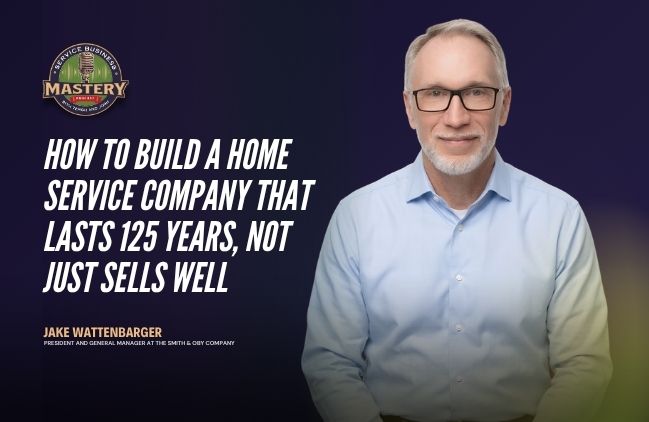
Smith & Oby’s articles of incorporation date back to March 1898. Jake Wattenbarger, President and General Manager at The Smith & Oby Company, described sending them off for a bid prequalification and joking that the document looked like it belonged next to the Declaration of Independence. That level of longevity is rare in any industry, let alone construction and mechanical services, where Wattenbarger pointed out a huge percentage of even the largest Fortune 500 companies fail within a few decades. Wattenbarger joined Tersh Blissett and Josh Crouch on the Service Business Mastery podcast to talk about what’s kept a mechanical contracting company relevant through two world wars, the Great Depression, and now the AI era, and why building a business meant to last looks very different from building one meant to sell. This article covers Wattenbarger’s philosophy on building a legacy home service business: the specific technology investments that kept Smith & Oby ahead of the market, how the company approaches the union labor pipeline, and why staying in business isn’t just about avoiding failure, it’s an active, ongoing decision.Why This Matters Right Now
Private equity consolidation is reshaping home services at a rapid pace, and the dominant narrative in the industry is built almost entirely around the exit: build a business, grow its value, sell for a headline-grabbing number. Wattenbarger offered a useful counterpoint. A privately held company with a meaningful ownership stake can generate the same kind of wealth over time as a sale, without giving up the business entirely, and it can leave something behind that a one-time payout never will. Crouch drew the comparison directly: it’s rare today to see any business, let alone a mechanical contractor, still standing after 125 years, especially when you consider the company’s earliest years happened before cars were a common way to move materials and people around.Core Insight #1: Staying Relevant Means Investing Before You Need To
Wattenbarger’s central argument is that Smith & Oby’s longevity comes down to one recurring pattern: making investments in technology and equipment before the market forced their hand, not after. Bite-size takeaways:- Roughly 15 years ago, Smith & Oby built out a dedicated Building Information Modeling (BIM) and Virtual Design and Construction (VDC) department, at a time when that wasn’t yet standard practice among local mechanical contractors in their market.
- The company invested early in shop equipment upgrades, like Watts pipe cutters and grooving stations, that let existing staff produce significantly more output without adding headcount. Wattenbarger was direct about the financial impact: those investments didn’t just help the company scale, they turned directly into margin.
- About a year and a half ago, Smith & Oby adopted Stratus, a cloud-based platform connecting BIM models, fabrication shop floors, and field crews into a single workflow built specifically for the mechanical, electrical, and plumbing (MEP) space. Shop staff no longer work from paper blueprints; they pull up models directly on large monitors on the shop floor.
- Field foremen carry iPads and can flag constructability issues directly with coordinators in real time, catching problems before a costly fabrication mistake happens, rather than discovering it on-site.
- Service technicians have carried mobile technology for roughly a decade, well before it became standard across the industry, another example of Wattenbarger’s broader philosophy: adopt early, but not so early that you’re stuck holding an outdated system a few years later.
Core Insight #2: Vertical Integration Turns Capability Into Leverage
Real example from the episode: Wattenbarger described the pitch this vertical integration makes possible to large commercial clients: rather than a customer needing to hire separate contractors for piping, sheet metal fabrication, and plumbing, and then coordinate clash detection between all of them, Smith & Oby can execute the entire scope in-house. His framing to clients is straightforward: no need to look anywhere else, and if something goes wrong, there’s only one company to hold accountable. Industry implications:- Fabricating both pipe and sheet metal in-house, rather than subcontracting out one trade, removes a coordination layer that often introduces delays and finger-pointing on complex commercial projects.
- Wattenbarger noted that adapting standards to match market realities matters even when it’s not necessarily the “better” technical choice. He cited the data center construction boom as an example: some clients originally specified welded pipe, but a shortage of skilled welders has pushed even that highly technical, safety-critical sector toward more grooved-fitting connections simply to keep projects moving.
- His advice for finding that balance: aim to be near the leading edge of a market shift, not so far ahead that the investment becomes an “8-track,” a technology that seemed cutting-edge at the time but became obsolete before it paid off.
Core Insight #3: Building the Labor Pipeline in a Union Market
A significant part of the conversation covered how commercial mechanical contracting handles workforce development differently than residential HVAC, particularly in a heavily unionized market like Cleveland.- Understand the union apprenticeship pipeline. Smith & Oby is signatory across three trades (pipefitters, plumbers, and sheet metal workers), and Wattenbarger sits on the Joint Apprenticeship and Training Committee (JATC) for the local pipefitters union, helping evaluate new apprentice candidates. A standard apprenticeship runs five years, split into on-the-job hours and classroom instruction, with the service side running closer to seven years due to added refrigeration and diagnostic training.
- Recruit from residential HVAC when union halls can’t keep up. Wattenbarger noted that union apprenticeship pipelines often can’t supply candidates fast enough for current demand, so Smith & Oby actively recruits technicians already working in residential HVAC and helps unionize them, sometimes bringing them in directly as third- or fourth-year apprentices.
- Build close relationships with local union business agents. Wattenbarger was direct that unionizing new talent isn’t something a contractor can do unilaterally, it requires an active, trusted relationship with the local hall’s leadership.
- Consider a mentor-protégé relationship to help smaller union shops get established. Smith & Oby has directly mentored a smaller, newly signatory contractor, giving them office space and helping them navigate the process of becoming signatory to the same union agreements, partly because that entry barrier is steep enough that few new union shops start from scratch successfully.
- Weigh the tradeoffs of union labor honestly. Wattenbarger was candid that union labor costs significantly more once benefits and fringe contributions are included, in Smith & Oby’s case, upwards of $800,000 to $1 million a month in union remittances alone, but he views the tradeoff as buying a highly trained, safety-conscious, and continuously educated workforce.