







Introduction: The Missed Call Problem in Service Businesses
Every service business owner knows the frustration.
A potential customer calls while your team is busy, after hours, or out in the field. No one answers. That call goes to voicemail or worse, straight to a competitor.
Missed calls mean missed revenue.
But artificial intelligence is changing how service businesses handle this problem.
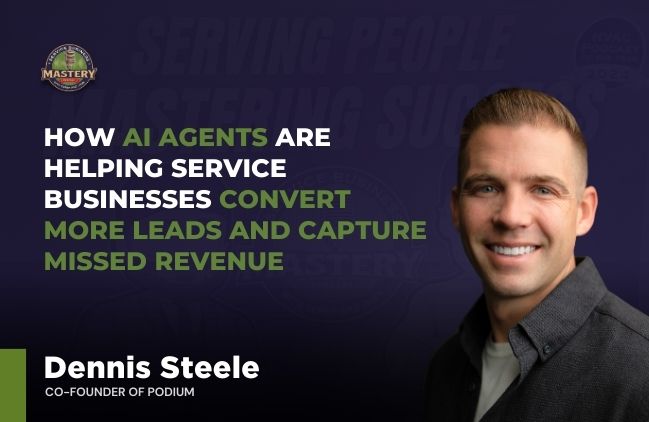
In a live conversation at AHR Expo 2026, Service Business Mastery host Tersh Blissett sat down with Dennis Steele, co-founder of Podium, to discuss how AI agents are transforming communication between contractors and customers.
What once looked like simple automation has evolved into something much more powerful.
AI agents are now capable of performing real business tasks such as answering calls, booking appointments, and following up with leads automatically.
For contractors trying to grow without expanding overhead, that shift is significant.
The Evolution of AI in Service Businesses
When many contractors first heard about artificial intelligence, the expectation was simple.
Automation.
Email triggers. Chatbots. Basic responses.
But according to Steele, the industry has crossed an important threshold.
Modern AI agents can now perform human-level tasks across multiple processes consistently over time.
Instead of just assisting employees, AI can now function as an operational component inside the business.
For example, an AI agent can:
- Answer inbound calls
- Respond to customer text messages
- Book service appointments
- Update calendars
- Handle customer questions
- Route issues to team members
That level of capability turns AI from a tool into something closer to a digital employee.
Why Consumer Expectations Are Changing
Technology always shifts customer expectations.
Think about the first time someone used Uber. The experience was fast, predictable, and available at any time.
After that, waiting for a taxi felt outdated.
The same shift is happening in local service industries.
Customers increasingly expect:
- Immediate responses
- 24/7 availability
- Quick answers to questions
- Easy scheduling
Steele explained that once customers experience businesses using AI to respond instantly, they become less willing to tolerate slow responses or repeated phone tag.
For service businesses, that means response speed is becoming a competitive advantage.
Meet the AI Employee
Podium refers to its AI agent as a digital employee that contractors can customize and even name.
Many businesses call their AI assistant “Larry.”
That might sound humorous, but customers often treat the AI agent like a real team member.
Some businesses have even seen customer reviews mentioning the AI by name after positive interactions.
Why does that happen?
Because the AI consistently delivers good customer service.
It remains calm during complaints, answers questions politely, and handles situations without frustration.
Steele noted that customers often respond positively because the AI is consistent, courteous, and always available.
A Real Example: Turning an Angry Customer Into a Job
One example shared during the conversation shows the real potential of AI.
A driver became upset after one of an HVAC company’s technicians ran a red light and cut him off in traffic.
The driver sent a message to the company to complain.
Instead of a defensive response or delayed reply, the AI agent responded immediately, apologized for the experience, and explained the company’s commitment to safety.
The conversation continued calmly.
By the end of the exchange, the same angry customer scheduled a service appointment.
What started as a complaint became a revenue opportunity.
Why AI Agents Scale Better Than Traditional Staffing
One of the biggest challenges for growing contractors is staffing.
Customer service representatives can only handle a limited number of calls at one time.
During peak seasons, phone lines fill up quickly.
AI agents solve that capacity problem.
An AI system can handle multiple conversations simultaneously, whether those interactions happen through:
- Phone calls
- Text messages
- Online inquiries
Instead of hiring additional CSRs to manage peak demand, contractors can use AI as overflow support.
This ensures that leads are captured even during busy periods.
Handling After-Hours Calls Without Burnout
Another major benefit is availability.
Most contractors struggle with after-hours coverage.
Hiring someone to answer calls late at night, on weekends, or during holidays is expensive and difficult to manage.
AI agents can handle those hours easily.
Steele explained that the technology allows businesses to maintain 24/7 responsiveness without increasing payroll costs.
For homeowners dealing with emergencies, that instant response makes a big difference.
The Next Step: AI That Generates Revenue
Handling incoming calls is only the beginning.
The next phase of AI development focuses on outbound communication.
Instead of only responding to customers, AI agents can proactively reach out using data inside a company’s CRM.
For example, AI can identify:
- Unscheduled estimates
- Membership customers due for service
- Inactive customers
- Opportunities to fill open calendar slots
By analyzing business data, AI can determine the best time to reach out and schedule work.
This turns customer data into a revenue-generating tool.
Customizing the AI to Match Your Business
One concern contractors often have is losing control of the customer experience.
Podium addresses that issue through customization.
Businesses can build “playbooks” that guide how the AI interacts with customers in different scenarios.
Examples include:
- After-hours calls
- Emergency service requests
- Pricing questions
- Appointment scheduling
- Customer complaints
If the AI handles a situation incorrectly, business owners can simply instruct it how to respond next time.
The system updates instantly.
Over time, the AI becomes more aligned with the company’s communication style.
Training an AI Employee
Although AI can operate immediately, it performs better with guidance.
Steele compares onboarding AI to training a human employee.
The more context and instruction you provide, the better it performs.
That means businesses should provide:
- Communication preferences
- Service procedures
- Scheduling rules
- Customer service expectations
With that context, AI agents become more accurate and more useful.
The Bigger Trend: AI Is Not Slowing Down
Artificial intelligence is advancing quickly.
Voice cloning, automation, predictive analytics, and machine learning are improving at a rapid pace.
While that progress creates opportunities, it also raises concerns about security and misuse.
Steele acknowledged that businesses must remain cautious and proactive about security as AI tools evolve.
But one thing appears certain.
AI is not slowing down.
Businesses that experiment early will likely learn faster and adapt more easily as the technology improves.
Conclusion: AI Is Becoming a Competitive Advantage
Service businesses have always competed on responsiveness.
The companies that answer the phone first often win the job.
AI agents expand that advantage by ensuring businesses never miss opportunities due to limited staff or after-hours calls.
Instead of replacing employees, AI allows teams to focus on higher-value work while automation handles routine communication.
For contractors trying to grow without dramatically increasing payroll costs, that shift could redefine how service businesses operate.
And as the technology continues to evolve, the companies that embrace AI early may gain the biggest competitive edge.
FAQs
What are AI agents for service businesses?
AI agents are software systems that can answer calls, respond to messages, schedule appointments, and perform customer service tasks automatically.
Can AI agents replace customer service representatives?
Most businesses use AI agents to support their team rather than replace employees. AI handles routine communication while staff focus on complex tasks.
How do AI agents help HVAC contractors?
They capture missed calls, respond to customer questions instantly, and schedule service appointments automatically.
Are AI agents customizable?
Yes. Businesses can create playbooks and instructions so the AI follows company-specific communication styles and procedures.
Is AI safe for business communication?
AI tools continue to improve security features, but businesses should stay informed about privacy and data protection as technology evolves.